From Blue Waves to Silver Cans: Maintaining Fish Quality from Sea to Factory
By. Fajar - 23 Feb 2026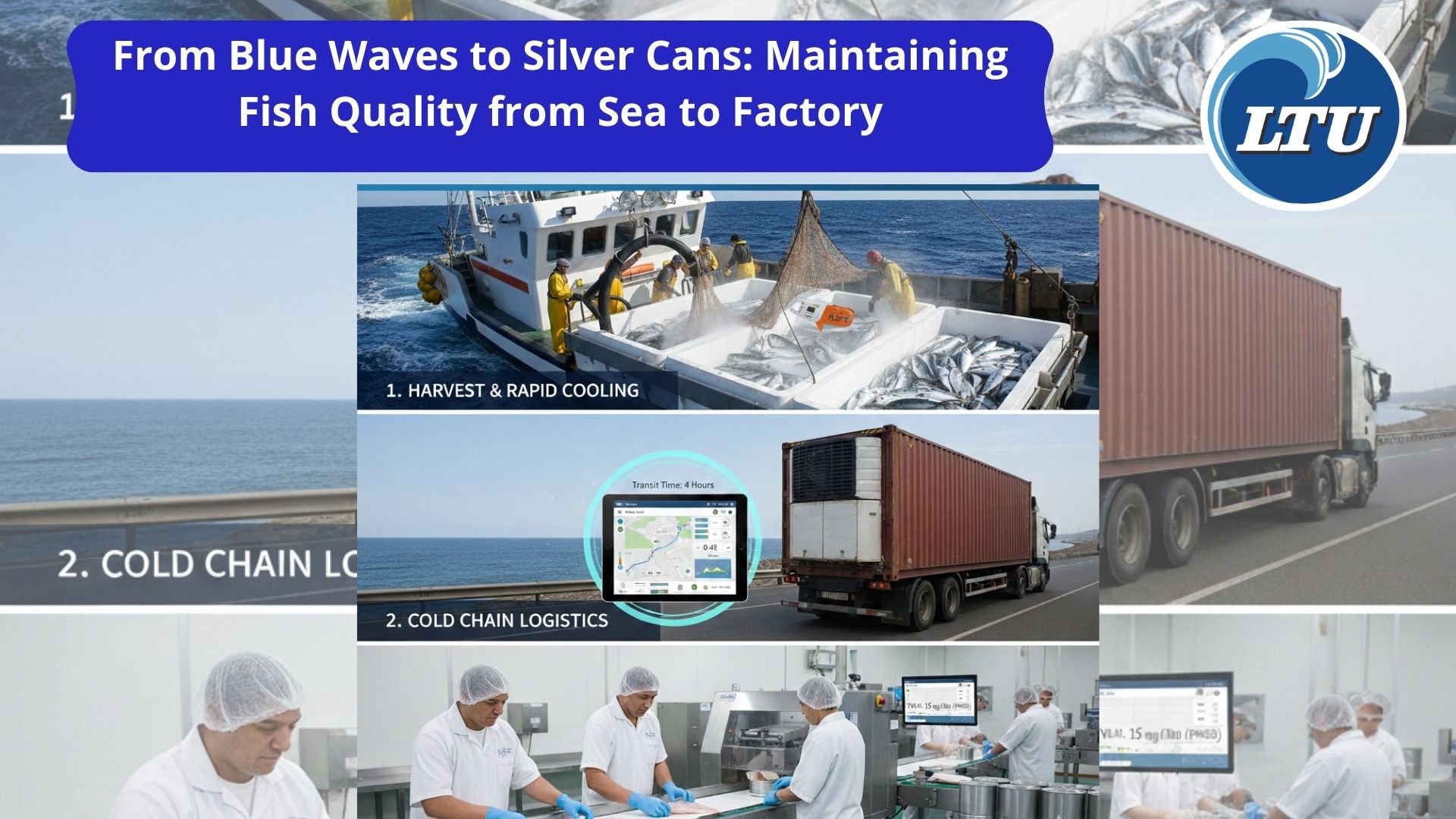
lauttimurutama.com The journey of a fish from the vast, unpredictable ocean to the sterile, organized environment of a processing factory is a race against time and biology. Seafood is one of the most perishable commodities on Earth. From the moment a fish is pulled from the water, a series of complex enzymatic and bacterial processes begin to break down its cellular structure. Maintaining quality during this transition is not just about preserving taste—it is a critical operation involving advanced logistics, rapid cooling, and meticulous handling.
1. The Critical "Golden Hour" on the Vessel
Quality control begins the second the net is hauled in or the line is pulled. The first hour post-harvest, often called the "Golden Hour," determines the shelf life and grade of the product.
- Gentle Handling: Physical damage, such as bruising or skin tears caused by rough handling, accelerates spoilage. Modern vessels use "pumping" systems or specialized slides to minimize physical impact, ensuring the flesh remains firm and intact.
- Rapid Bleeding and Gutting: For many high-value species like tuna or salmon, immediate bleeding and evisceration are essential. This removes blood and internal organs that house spoilage-causing bacteria and enzymes, preventing them from migrating into the muscle tissue.
2. The Power of the Cold Chain: $0^\circ\text{C}$ is the Goal
Temperature is the single most important factor in seafood logistics. The primary goal of any fishing operation is to lower the fish's core temperature to as close to $0^\circ\text{C}$ as possible without freezing the cells.
Onboard, this is achieved through various methods:
- Slush Ice (RSW): Refrigerated Seawater (RSW) systems are common on modern trawlers. The fish are submerged in a mixture of ice and seawater, which provides rapid, uniform cooling and keeps the fish buoyant to prevent crushing.
- Flake Ice: Smaller vessels use layers of flake ice. The ice must be distributed evenly around each fish to avoid "hot spots" where bacteria can thrive.
Every $5^\circ\text{C}$ increase in temperature can double the rate of spoilage. Therefore, maintaining a strictly monitored Cold Chain from the deck to the factory loading dock is non-negotiable.
3. Preventing Histamine and Chemical Degradation
In certain species like mackerel and tuna, improper cooling leads to the decarboxylation of the amino acid histidine into histamine. This is a heat-stable toxin that cannot be destroyed by cooking or canning later.
By maintaining strict temperature controls during transport, the industry prevents "Scombrotoxin" poisoning. Furthermore, the use of food-grade antioxidants may be applied to fatty fish to prevent oxidative rancidity, which causes that unpleasant "fishy" smell and yellowing of the fat layers.
4. Logistics: The Bridge to the Factory
The journey from the port to the factory is often the "weak link" in the quality chain. To mitigate this risk, the industry utilizes:
- Insulated Transportation: Trucks equipped with GPS-linked temperature sensors provide real-time data to quality managers. If a refrigeration unit fails, an alert is sent immediately to prevent a total loss of the cargo.
- Traceability Systems: Modern batches are tagged with digital IDs. This allows the factory to know exactly how long the fish has been out of the water, the temperature history of the hold, and the specific area of catch.
5. Arrival and Primary Processing
Upon arrival at the factory, the fish undergoes a "sensory and chemical audit." Quality assurance (QA) teams check for:
- Organoleptic Indicators: Clear eyes, bright red gills, and firm flesh that "springs back" when pressed.
- Total Volatile Basic Nitrogen (TVB-N): A chemical test used to measure the level of nitrogenous bases, which indicates the degree of protein breakdown.
Only fish that pass these rigorous checks proceed to the processing line. In the factory, the environment is kept at a low ambient temperature, and water used for cleaning is strictly filtered and chlorinated to prevent cross-contamination.
6. The Ethical and Economic Impact
Maintaining quality is not purely a technical challenge; it is an economic necessity. High-quality fish translates to less waste, higher market prices, and stronger consumer trust. From a sustainability perspective, it is a tragedy to harvest life from the ocean only to have it discarded due to poor temperature management. By investing in better onboard cooling and faster logistics, the industry honors the resource it relies upon.
If youre interested in our Red / Scarlet Snapper Whole Round / Whole Gilled Gutted Scaled,Emperor Fillet Skinless,White Snapper Pearl Perch Whole Round / Whole Gilled Gutted Scaled please do not hesitate to contact us through email and/or Whatsapp